
The peak GST rate of 28 per cent as also the 5 per cent ad valorem cess will continue
Inter-state supply may come under GST composition
Seven of the meetings will be held in late November or early December at the finance ministry, as is the norm.
Bihar Deputy Chief Minister Sushil Kumar Modi said, a hike in GST rates would have hampered consumption amid the economic slowdown. The revenue augmentation panel in the Council meeting recently recommended revisiting and restructuring the GST rate slabs, besides correcting the inverted duty structure. The panel listed 24 items, including mobile phones, footwear, fabrics, LED light, medical equipment, utensils, agri machinery, pharma, and renewable components, which have an inverted duty structure, resulting in refunds of close to Rs 20,000 crore annually.

At present, except Trai, all regulators and the Competition Commission of India (CCI) have powers to levy penalty in case of violation of any rule or law. The GST anti-profiteering authority will be the only institution which will not have the same.

He also said GST will take about a year to stabilise.

The GST Council is scheduled to meet next on November 10 and may consider lowering tax rates on a host of goods such as handmade furniture, plastic products and daily use items like shampoo.

This meeting has led to the deferment of the Goods and Services Tax (GST) Council meeting by a day.

GST compensation law allows for imposition of cess on certain luxury goods like tobacco, high-end cars and aereated drinks to create a corpus for compensating states for any loss of revenue in the first five years

Once implemented, customers making payments using Rupay card or BHIM UPI will get a cashback of 20 per cent of the total GST amount, subject to a maximum of Rs 100.

GST rates would depend upon whether the commodity is used by a rich person or a common man
GSTN said those who do not want to give their Aadhaar numbers would have to undergo physical verification.
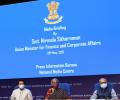
The GST Council on Friday left taxes on COVID-19 vaccines and medical supplies unchanged after the BJP- and Opposition-ruled states sparred over whether tax cut benefits will reach the common man. Congress and other Opposition ruled states have been demanding a reduction in taxes but the central government felt the move may not result in tangible gains for people. "It is one thing to rush to say - do this, it will benefit the common man. But when the technical, fitment and law committees go into the details, you realise that that could have collateral impact on many others," Finance Minister Nirmala Sitharaman said. "I am not talking about the revenue generation aspect, but how many other items will get included in it as a result of which how you are going to implement it," she added.

Certain clarifications by the GST Council, such as tax rates on ice cream parlours and royalty paid to state governments over mineral rights, may turn out to be contentious and lead to litigation, feel some experts. The council, at its meeting in Lucknow on Friday, had clarified that ice cream parlours will attract goods and services tax (GST). The clarification said these parlours sell already manufactured ice cream and such supply would draw 18 per cent tax.

Full exemption for all health insurance premiums and reinsurance or a reduction in the GST rate from 18% to 5% on health insurance services is likely.

"To begin with, people could face some difficulties because any changeover has its own problems. But it will settle down and the country will benefit from the new indirect tax regime," Jaitley said at an event organised by ABP News.

The Centre is against giving any shock in the first year of the rollout by bringing in new services.

With the total tax burden currently at 53 per cent, 19.5 per cent and 56 per cent, respectively for cigarettes, bidis and smokeless, tobacco taxation in India is much lower than the level recommended by the World Health Organisation.
'We crossed Rs 1.7 trillion in three months this financial year.'
All GST anti-profiteering complaints would be dealt with by the Competition Commission of India (CCI) from December 1 as the extended tenure of National Anti-profiteering Authority ends this month, an official said on Tuesday. A notification in this regard is expected to be issued by the finance ministry later this month, the official added. The National Anti-profiteering Authority (NAA) was set up in November 2017 under Section 171A of Goods and Services Tax (GST) law to check unfair profiteering activities by registered suppliers.

The clarification comes amid reports that sweet shops have discontinued chocolate barfis and chocolate sandesh.

Online skill-based gaming industry has made a case for retaining the service under 18 per cent GST slab instead of putting it into the highest 28 per cent tax rate category, saying the move will badly hit the $2.2-billion sector. The increase in taxation would not only have catastrophic impact on the industry but also encourage offshore operators who would circumvent Indian tax jurisdiction by hosting games in some other country, Games24x7 Co-CEO Trivikraman Thampy said. "It would be a triple whammy -- the industry loses out, the government loses out on tax revenue and players loses out as they would be exposed to unscrupulous operators," he said.

Although the markets could see a knee-jerk reaction, they rule out a sharp fall.

The government on Monday announced the implementation of a 5 per cent uniform IGST rate on all aircraft and aircraft engine parts to boost the industry. The decision, which comes into force with immediate effect, marks a significant milestone for the domestic Maintenance, Repair, and Overhaul (MRO) industry, aimed at making India a global aviation hub, an official release said. Earlier, IGST rates on all aircraft and engine parts were ranging from 5 per cent to 28 per cent.

Proposals from the Centre's side include raising the 5 per cent slab to anywhere between 6 and 8 per cent, and doing away with the 12 per cent slab. A few states may oppose such a move because it involves hiking tax on items consumed by the poor. They have instead proposed raising the 18 per cent slab.
Retaining the GST rate assumes importance since states are under pressure to increase their revenues, hit hard by lockdown. Also, the Centre has not fully compensated states for their revenue losses on account of GST for 2019-20.
The collections stood at Rs 98,202 crore in the month, against Rs 1.02 trillion in July. The figures indicate continuation of economic slow down which was reflected in the gross domestic product (GDP) growth which plummeted to a 25-quarter low of 5 per cent in the first quarter of 2019-20, experts said.

"At present, there are two main rate slabs under which sa majority of goods are covered -- five per cent and 12.5 per cent -- which will now increase to three (five per cent, 12 per cent and 18 per cent).Will this result in multiple litigations is anybody's guess."

These have to be passed in this session to meet the September 15 deadline for switching over to the new indirect tax regime, Jaitley said.

A 5 per cent GST rate kicked in on Monday on pre-packed and labelled food items such as cereals, pulses and flour weighing less than 25 kg.

The Director General of Goods and Services Tax Intelligence (DGGI) has slapped its heftiest tax notice of Rs 21,000 crore on Bengaluru-based Gameskraft Technology (GTPL) for allegedly evading GST on the betting amount. Gameskraft has dubbed the notice a "departure from the well-established law of the land". The company is accused of promoting online betting through card, casual and fantasy games like Rummy Culture, Gamezy and Rummy Time.
Experts said the rate hike would improve working capital position of the manufactures as it would correct the inverted duty structure but may lead to increase in price of the finished goods.

After the 2019 election, one thing is sure: GST will see a number of changes, explains Indivjal Dhasmana.
Rationalisation of rates will be taken up for smaller items that do not have major revenue implications but are commonly consumed at the GST Council meet on Saturday

The consensus was reached after the Centre agreed to the demand of states to go in for horizontal split

Agriculture implements that are currently taxed up to 18 per cent may come under the 12 per cent or the 5 per cent bracket.

For the week, the Sensex recorded a fall of 371 points, or 1.10 per cent, and the NSE Nifty 130.75 points, or 1.25 per cent.

While the government has the option of ensuring the passage of these Bills as money Bills, there are voices within the government advising discretion on the GST roll-out by April 1.
Supplying food to schools under mid-day meal scheme, pre-schools and anganwadis is exempt from GST, the Central Board of Indirect Taxes and Customs (CBIC) has said. Issuing a set of clarification on certain decisions taken by the GST Council in its 43rd meeting on May 28, the CBIC said it had received representations regarding applicability of GST on the issues as to whether serving of food in schools under mid-day meals scheme would be exempt if such supplies are funded by government grants and/or corporate donations. Under the goods and services tax (GST), any catering service, including mid-day meals, provided to an educational institution is exempt from the levy.

The business would also not be allowed to claim any un-availed input tax credit for "goods lost" or "destroyed".
 © 2026 Rediff.com - Advertise with us - Disclaimer - Privacy Policy - Sitemap - Feedback - About us - Terms of use - Grievances